Why Business Videos Belong on Your Website | Go Savvy Social
Your Business Videos Belong on Your Website—Not Just Social Media
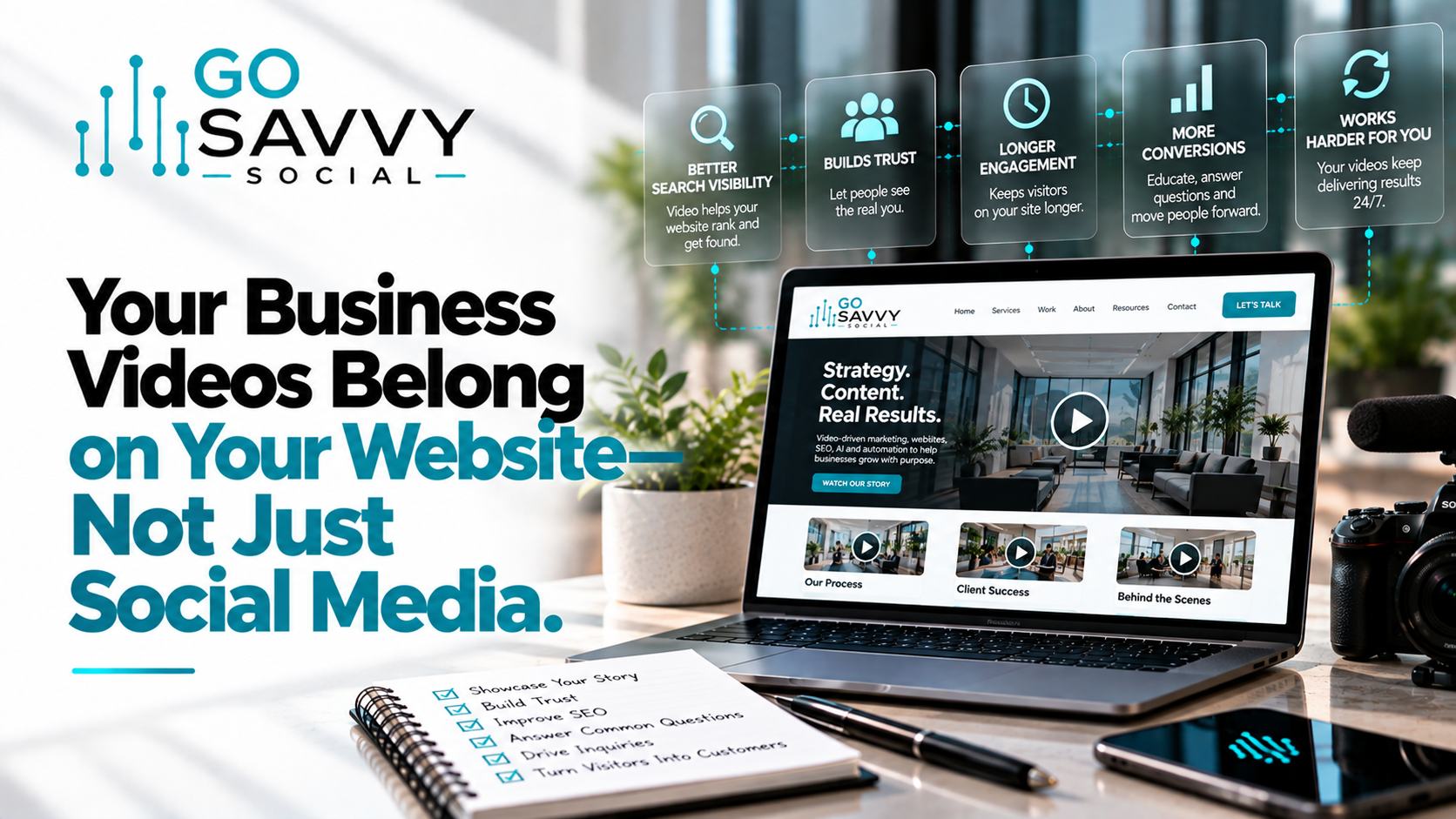
You're creating valuable content. Why does it disappear into the feed?
Businesses are investing more time, money, and energy into video.
Owners are getting comfortable on camera. Employees are explaining their expertise. Companies are filming projects, answering customer questions, demonstrating products, and sharing behind-the-scenes moments.
Then the video gets posted to Facebook, Instagram, LinkedIn, or TikTok.
It receives attention for a few days.
And the business moves on to the next video.
Meanwhile, the company website still has the same service descriptions, stock images, and generic messaging it's had for years.
There's an opportunity being missed between content production and website development.
What if the videos you're already creating could become part of a more permanent, searchable library of your business's expertise?
Social media gives video distribution. Your website gives it context.
Social media platforms are powerful for introducing your business to people who might not otherwise encounter it.
They create opportunities for discovery, recognition, conversation, and community connection.
But a social feed moves quickly.
Your website serves a different purpose.
It's where people go when they want to investigate the business behind the content.
They want to understand your services, evaluate your experience, learn about your process, and decide whether you're relevant to their needs.
A useful video can make that experience significantly more informative.
Consider an HVAC company explaining what happens during a furnace replacement.
On social media, that video might capture someone's attention.
On the company's furnace replacement page, it can answer questions for people actively researching that service.
Same source material. Different job.
And that's the opportunity.
Your existing videos may already answer your customers' questions.
Before recording another ten videos, look at what your business already has.
Maybe there's a video of an employee explaining a complicated process.
Maybe you filmed a project from beginning to end.
Maybe your owner answered a question during a podcast interview.
Maybe a customer asked something on camera that your team answers every single week.
Those recordings can contain useful information that deserves a place on your website.
A manufacturer could add an equipment demonstration to a product or capabilities page.
A contractor could place a project walkthrough alongside the corresponding service.
An automotive training business could explain a technical concept through a video-supported educational article.
A consultant could turn part of a recorded conversation into a written guide with the original video embedded.
The point isn't to place a video on every page.
It's to match the right video with the right question, service, or customer need.
Embedding a video is only the beginning.
Here's where website video strategy becomes more interesting.
Adding a video player to a page gives visitors something to watch.
But search engines also need context to understand the page and its content.
Think about the information surrounding a business video.
Does the video have a descriptive title?
Is there a clear explanation of what someone will learn?
Does the page contain relevant written information?
Is the video connected to the correct service or topic?
Can a visitor quickly understand why the video matters?
These are valuable questions even before we get into technical search optimization.
A video titled "Project 004 Final" tells an audience very little.
A video titled "What Happens During a Commercial HVAC Installation?" communicates a specific subject and a reason to watch.
Good organization helps people first.
It also gives search systems clearer information to work with.
The video itself has information that belongs in your website's backend.
Many businesses are familiar with basic website SEO.
They understand that pages have titles, descriptions, URLs, and other technical settings.
Videos have their own information worth defining.
One way websites can communicate this information is through structured data.
A structured data format called VideoObject can describe a video in a machine-readable way.
Depending on the implementation, that information can include the video's name, description, thumbnail, original upload date, duration, creator, and location of the video player or file.
Google identifies the video name, thumbnail URL, and upload date as required properties for its VideoObject search feature. Other details can provide additional context.
But the distinction matters:
Structured data is not a shortcut to better rankings, guaranteed indexing, or inclusion in AI-generated answers.
It's a way to provide accurate, organized information about content that actually exists.
The website still needs to be accessible, useful, and technically sound.
Adding VideoObject markup without an appropriate video and supporting page doesn't accomplish the objective.
A transcript can make the content useful beyond the video.
Not everyone wants to watch a video.
Some people would rather read.
Others are researching in an environment where watching with sound isn't practical.
A transcript, edited summary, or supporting article gives visitors another way to access the information.
It also gives the page relevant written content.
Imagine a ten-minute interview with a business owner explaining how their manufacturing process works.
Instead of embedding the interview alone, the page could include a brief introduction, the video, useful section headings, a written explanation of the process, and links to related services.
Now the visitor has several ways to learn.
The business also has a more complete piece of content instead of one isolated media file.
A transcript shouldn't be treated as a reason to dump thousands of unedited words onto a page.
Organize the information so it's understandable and genuinely useful.
Not every embedded video becomes a Google video search result.
This is an important distinction that businesses should understand.
A relevant video embedded on a service page can improve the information available to visitors.
But Google's video indexing requirements are more specific.
For dedicated video search features, Google recommends an indexable watch page where viewing an individual video is the main purpose of the page.
That means a video added to a service page and a dedicated video watch page may serve different purposes.
Neither makes the other unnecessary.
A service page may be the right destination for someone evaluating an HVAC installation.
A dedicated video page may be appropriate for someone searching for a detailed educational demonstration.
A business doesn't necessarily need a separate page for every short social clip.
It needs a thoughtful approach to deciding where the video adds the most value.
YouTube and your website shouldn't compete for attention.
Businesses sometimes think they have to choose between uploading videos to YouTube and putting videos on their websites.
That's not the right way to look at it.
YouTube can be a discovery platform and a place to organize video content.
Your website connects that content to your business, services, educational resources, and next steps.
A business can embed a relevant YouTube video on its website and provide additional context around it.
Google may discover eligible videos through both the hosting platform and the embedding website, but indexing isn't guaranteed for either location.
The point is not to force every platform to do the same job.
It's to make the content more useful wherever people encounter it.
One recording can support more than one business objective.
Consider a single recorded conversation with an experienced employee.
That recording might become a short social video introducing the employee's expertise.
A second clip could answer a common customer question.
The full explanation could support a service page.
A written article could expand on the subject.
A related video could become part of a customer education library.
The material could even help the sales team explain a process to a prospective customer.
That's a more connected content strategy.
And it doesn't necessarily require producing more raw footage.
It requires recognizing how useful information can be organized and distributed.
Start by reviewing what you've already recorded.
For many businesses, the first step isn't hiring another video crew or rebuilding the website.
It's opening the folder containing existing media.
Look for recordings that explain something, demonstrate something, answer a customer question, or show expertise that competitors aren't communicating.
Then determine where that information belongs.
Does it support an existing service page?
Would it be more useful as a dedicated educational article?
Is it substantial enough for a video resource page?
Does it need a transcript, better title, updated thumbnail, or additional context?
And does the website have the appropriate technical structure to help search engines discover and understand it?
You may find that some of your most useful website content has already been filmed.
It just hasn't been connected to the website yet.
The future of website content isn't necessarily more content. It's more connected content.
Businesses are often encouraged to produce more.
More posts. More videos. More articles. More pages.
But volume alone isn't a strategy.
A company can create hundreds of social videos and still leave its website with very little original expertise.
A smaller, intentionally organized content library may provide a more useful experience than a collection of disconnected posts.
The opportunity is to make content work harder across the business.
Social media can introduce people to your expertise.
Video can demonstrate it.
Written content can explain it.
Structured data can describe it to supported search systems.
And your website can connect those elements in one place.
Your videos shouldn't stop being useful when the social media feed moves on.
Make the content you're already creating work harder.
At Go Savvy Social, we believe video production, website development, organic visibility, SEO, AEO, GEO, and business development should support one another.
Not as disconnected deliverables, but as parts of a more useful digital presence.
The objective isn't to promise viral videos, first-page rankings, AI citations, or conversions.
It's to build recognizable brands, communicate genuine expertise, and create more opportunities for businesses to be discovered and understood.
Go Savvy Social | Signal. Strategy. Execution.