How AI Search Is Changing Website Development | Go Savvy Social
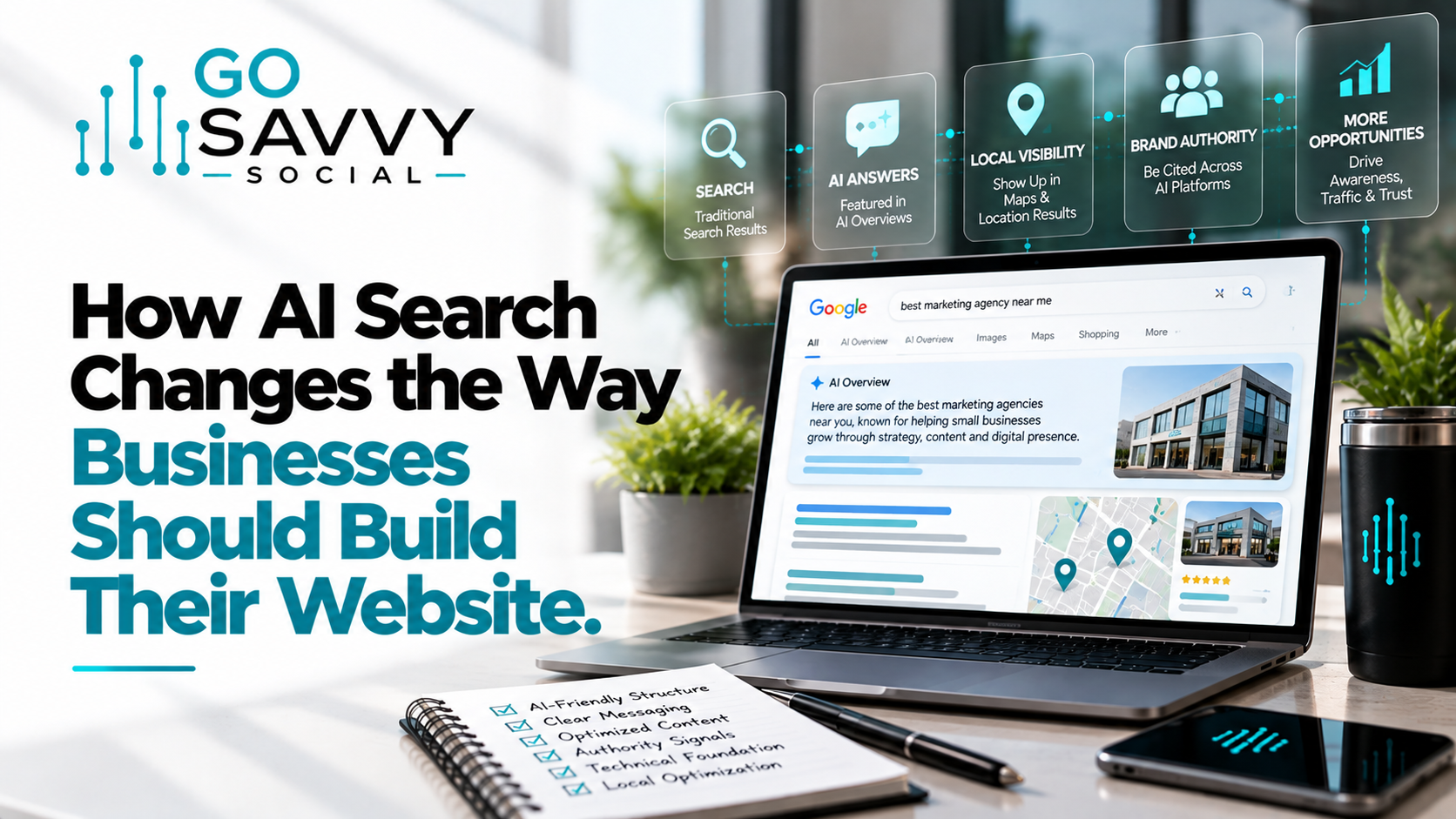
The website has to explain the business without a salesperson in the room
Traditional search already rewarded clarity. AI search makes that requirement even more obvious.
If your website uses vague language, hides services inside one giant page, and rarely publishes specific expertise, you're making it harder for people and search systems to understand what your business actually does.
A website should answer questions, demonstrate capabilities, and establish credibility before someone ever picks up the phone.
And increasingly, that requires thinking beyond traditional website design.
One page should have one primary job
Your homepage should explain your company.
A service page should clearly explain one capability.
An industry page should demonstrate how that capability applies to a specific audience.
An article should answer a real question someone is researching.
This approach creates clearer information paths for both people and search engines.
Businesses don't necessarily need more pages. They need pages that serve a purpose, communicate clearly, and connect logically.
Original experience matters more as generic content gets easier to create
Anyone can generate another article about the five benefits of artificial intelligence.
Far fewer businesses can explain what they've actually tested, what failed, what customers consistently misunderstand, or what their team learned while solving a difficult problem.
That experience is valuable.
A manufacturing company can explain how a process works. A contractor can show what happens during a complicated installation. A business owner can discuss what changed after implementing a new system.
These are the kinds of insights that differentiate one business from another.
Your website should become a place where that knowledge lives.
Video belongs on your website, not just in your social media feed
This is one of the opportunities businesses should be paying closer attention to.
Companies are investing significant time into filming customer education, employee expertise, project walkthroughs, interviews, demonstrations, and short-form social videos.
Then much of that content lives exclusively on social media.
Those platforms have value, but the content can also have a longer life on your website.
Imagine a prospective customer visits a service page and can immediately watch someone from your team explain what the service involves.
Or someone researching a technical question discovers a page containing a useful demonstration, a written explanation, and supporting information.
That creates a more complete experience than a paragraph of generic service copy.
But embedding a video is only part of the opportunity.
Search engines also need information that helps them understand what that video contains.
A descriptive title, relevant surrounding text, an accessible transcript or summary, and appropriate video structured data can all provide useful context.
For qualifying videos, VideoObject schema can identify information such as the video's name, description, thumbnail, upload date, and video location.
This doesn't guarantee search visibility or inclusion in an AI-generated answer.
It does help make the video's subject and technical details easier for supported search systems to interpret.
The opportunity is not simply to add more video. It's to connect the video to the right business information.
The backend of a website matters just as much as what visitors see
A beautiful website can still be difficult for search engines to interpret.
Behind the design are technical decisions that affect how content is discovered, understood, and organized.
These include descriptive page titles, metadata, structured data, internal linking, crawlability, indexing, and page-specific information.
Structured data can help identify an organization, business location, article, product, service-related information, or video when the appropriate schema type applies.
However, adding more markup is not automatically better.
The information should accurately represent what is visible on the page and follow the requirements of the search systems being targeted.
Businesses should be asking more than whether their website looks modern.
They should be asking whether it is technically organized to communicate what the business knows, provides, and represents.
Local businesses need to make their location and relevance clear
For local and regional businesses, geography still matters.
Your address, service areas, local projects, community participation, Chamber relationships, and location-specific expertise can help visitors understand where and how you operate.
This isn't an invitation to generate hundreds of nearly identical city pages.
Real local relevance comes from genuine connections, projects, experience, and useful information.
A business with meaningful involvement in its region has something more compelling to share than simply repeating city names throughout its website.
Your website should function as a connected knowledge system
An article should connect to the relevant service.
A service page should connect to related expertise, examples, and industry information.
A video should support the page where its topic is most relevant.
A case study should connect real experience to the services it demonstrates.
These connections make the website easier to navigate and help establish context.
Rather than treating each page, article, or video as a separate marketing deliverable, businesses should think about how those assets support one another.
The goal is to build a digital presence that becomes more useful as the business continues contributing information.
Your website isn't the only source of credibility
Search visibility doesn't happen in isolation.
People discover businesses through social platforms, referrals, local organizations, industry associations, interviews, video platforms, and online publications.
Accurate business information and legitimate third-party mentions help reinforce the identity and expertise represented on a company's website.
This is another reason that marketing, business development, media, and website strategy shouldn't operate independently.
They are contributing to the same larger picture of the business.
Measure more than where you rank
Traditional keyword rankings still have value, but they aren't the entire picture.
Businesses should also pay attention to search impressions, relevant queries, website engagement, branded search, referral activity, and customer conversations.
Google Search Console and Bing Webmaster Tools can help businesses understand aspects of their search visibility. Bing's AI Performance reporting also provides information about citations within supported AI experiences.
Not every interaction will be directly attributable to a sale.
Someone may see a video, encounter a business through an AI-assisted search, receive a recommendation, and visit the website days later.
Understanding how those touchpoints support awareness and consideration is often more valuable than expecting one metric to tell the whole story.
So, does AI search change the future of websites?
Yes. But not because websites are becoming obsolete.
If anything, businesses have a stronger reason to maintain a useful, technically sound website that they control.
The old model was often brochure first.
The opportunity now is to build a connected source of business knowledge.
Explain what you do.
Demonstrate what you know.
Answer the questions customers actually ask.
Show the people and processes behind the work.
Make your videos, articles, services, and supporting information work together.
And keep improving the information as your business evolves.
The strongest digital presence isn't necessarily the one with the most pages.
It's the one that makes a business easier to discover, understand, recognize, and trust.
Build a website that does more than exist
At Go Savvy Social, we look at websites as part of a larger business visibility and development system.
Website development, SEO, AEO, GEO, video, content strategy, and operational execution all contribute to how a business presents itself and gets discovered.
We don't promise search rankings, AI citations, leads, or conversions. We focus on building useful foundations, original content, and the consistency that supports long-term brand awareness.
Go Savvy Social | Signal. Strategy. Execution.