SEO vs. AEO vs. GEO: A Small Business Guide | Go Savvy Social
Three labels, one larger visibility problem
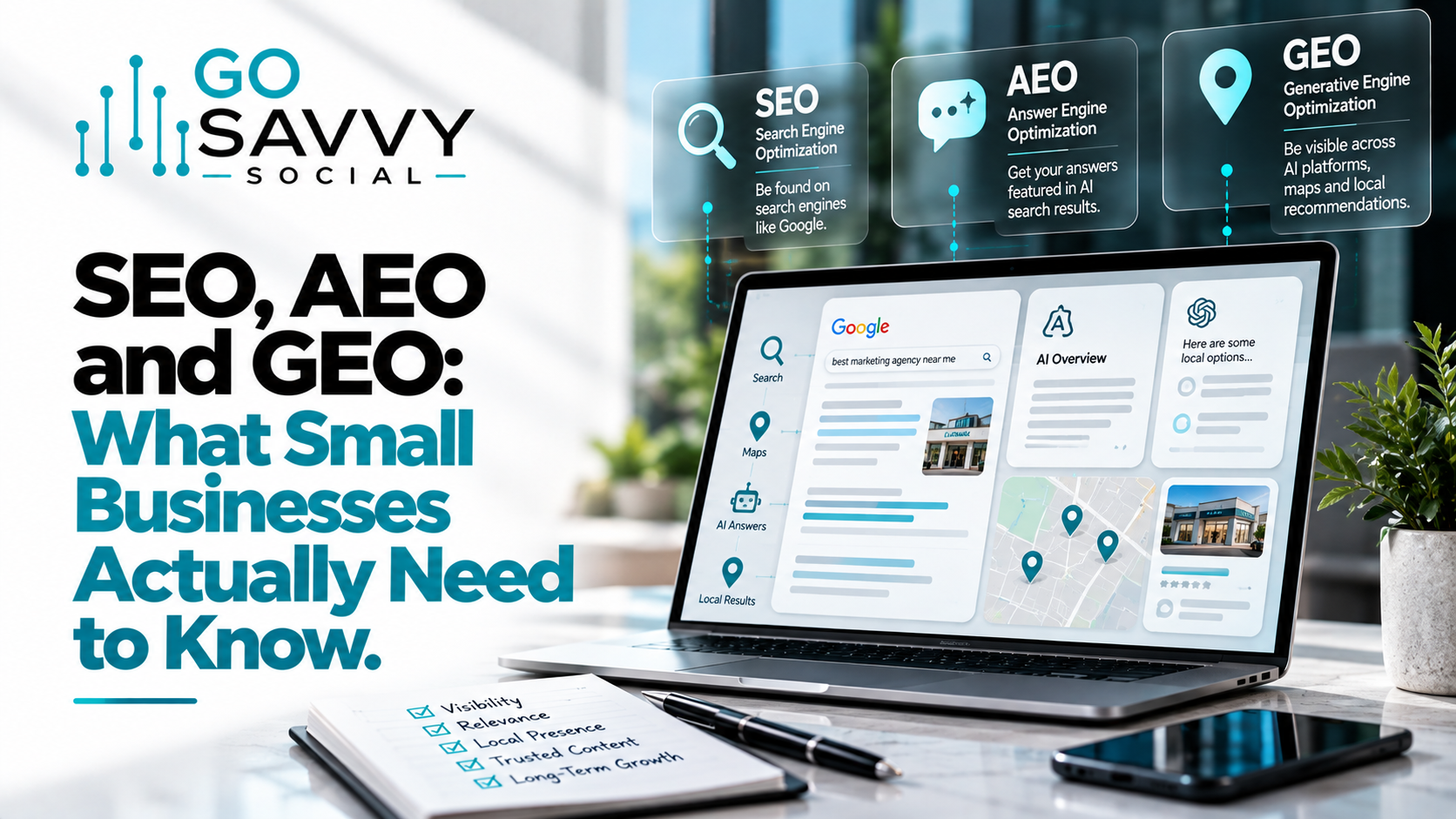
SEO usually refers to improving visibility in traditional search. AEO is commonly used for answer-oriented search experiences. GEO is commonly used for generative AI and AI-search visibility.
The labels can be useful for planning, but small businesses should be careful not to treat them as three completely separate marketing disciplines.
Google is explicitly pushing back on the idea of a secret AI-search playbook
Google's 2026 guidance on generative AI features says established SEO best practices remain relevant. It emphasizes useful, non-commodity content and calls out local, image and video content as important opportunities.
In other words, there is not a hidden metadata field that suddenly makes a business "AI optimized."
What SEO still means
Make important pages crawlable and indexable. Give each important service or topic a clear page. Use descriptive titles and headings. Keep URLs stable. Add internal links. Publish original information that answers the questions your audience actually has.
Make the business name, services, people and location consistent.
What answer-focused content adds
Answer systems benefit from clarity. Give the direct answer early. Use understandable headings. Define terms. Include examples. Keep each page focused enough that a machine can understand what problem it solves.
This also makes the page better for people.
What AI-search visibility adds
AI systems often synthesize information from multiple sources. That makes third-party validation, original experience and consistent entity information more important.
Your website should not be the only place on the internet confirming who you are. Chambers, associations, customer stories, interviews, videos and reputable local mentions help create a larger evidence trail.
Do not overbuild FAQ schema
Google removed the FAQ rich result feature from Search in 2026.
FAQs can still be useful for users and content clarity, but small businesses should not assume FAQ markup will create a special Google result.
Use structured data where it accurately represents the page rather than adding schema only because somebody sold it as a ranking trick.
The practical small-business plan
Build strong service pages. Publish real expertise. Add local proof. Use video. Keep Google Business and third-party profiles accurate. Earn legitimate mentions.
Measure queries in Search Console. Review Bing Webmaster Tools as well, especially now that Bing provides AI Performance reporting for citations across its AI experiences.
Visibility is bigger than ranking for a keyword
Businesses need to be discoverable, understandable and credible wherever their audiences are researching.
At Go Savvy Social, we connect website development, organic search, AI-search visibility, video content and business development to create a more complete digital presence.
We don't promise rankings, AI citations, leads or conversions. We build the foundation, consistency and original content that give brands more opportunities to be discovered and recognized.
Go Savvy Social | Signal. Strategy. Execution.