Why AI Projects Fail When the Process Was Never Defined
AI exposes process problems quickly
A business says, “We want AI to automate follow-up.” The first question is: what is the follow-up process now? If three salespeople give three different answers, automation is not the first project.
Undefined inputs create unreliable outputs
AI workflows depend on source information. If customer notes are incomplete, the CRM is inconsistent or nobody knows which document is current, the workflow starts with bad inputs. Automation can make the inconsistency faster and harder to see.
Ownership matters
Every process needs somebody responsible for the result. Who reviews the AI-generated draft? Who confirms a procedure is current? Who decides when a lead moves stages? Who handles exceptions? Without ownership, teams blame the tool for decisions nobody defined.
Exceptions are the real process
A whiteboard workflow often looks simple until employees explain what actually happens. “Unless it is a commercial customer.” “Unless the technician already spoke with them.” “Unless quality put the job on hold.” Those exceptions matter. They need to be discovered before the workflow is automated.
Define the minimum viable process
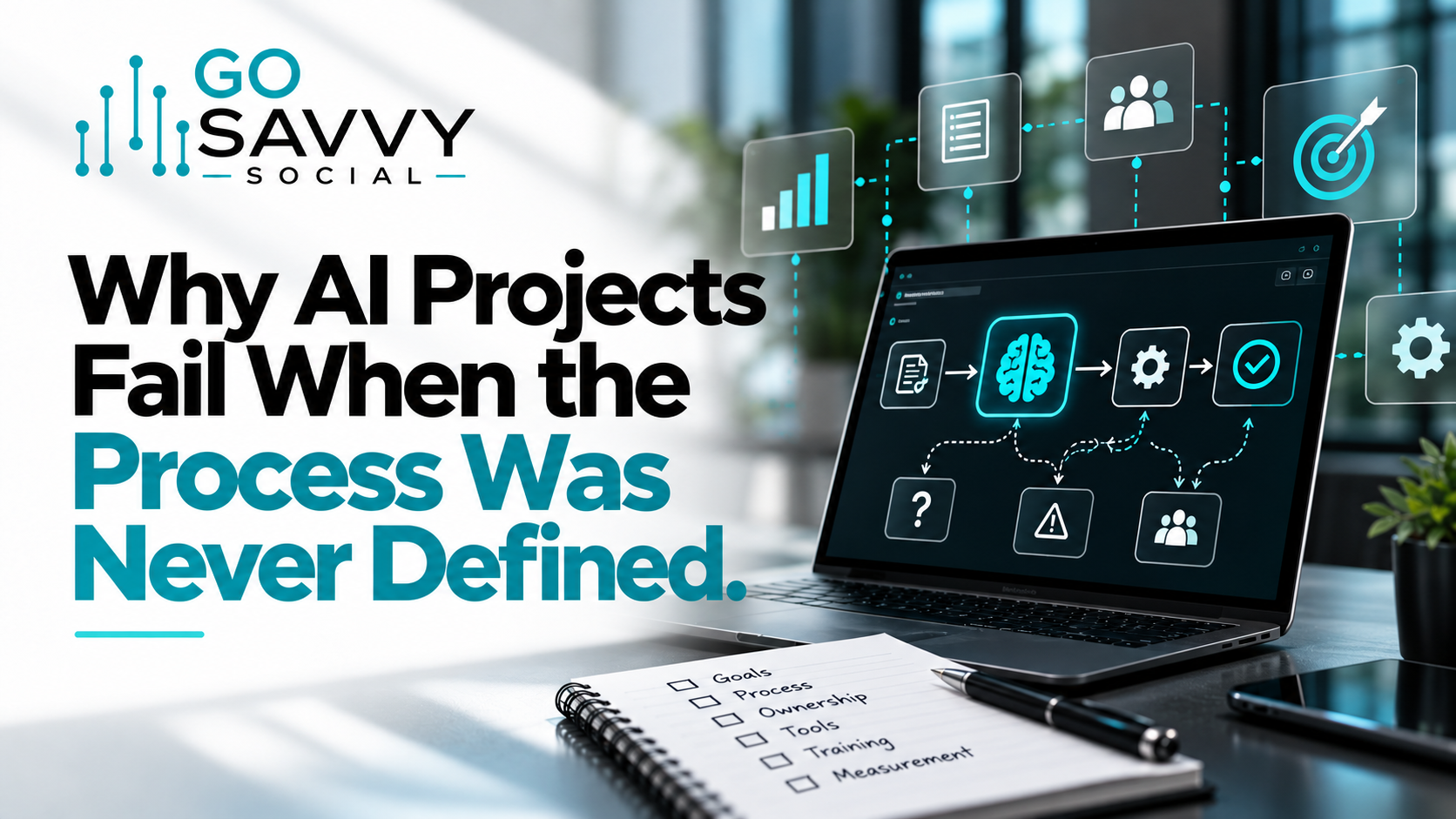
You do not need a six-month process-engineering project. Start with one page: trigger, inputs, steps, owner, review point, output, storage and exception path. That is enough to expose most ambiguity.
Then decide whether AI belongs
Once the process is visible, you may discover that AI is useful for one step rather than the whole thing. It may summarize the information, draft a response, classify a request or retrieve the right source. The human may still make the decision and complete the final action.
Success is adoption, not a demo
An AI project is successful when the people responsible for the work use it consistently and the business can see a useful improvement. A clever prototype nobody trusts is not implementation.
Before automating a workflow, draw the current process on one page.
If your team cannot agree on the steps, that's the first problem to solve.
Go Savvy Social helps businesses identify operational gaps, document existing processes and determine where AI and automation can create practical improvements.
Go Savvy Social | Signal. Strategy. Execution.